
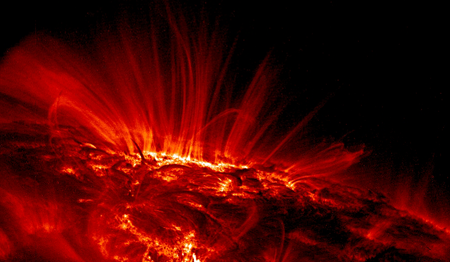
Interface Region Imaging Spectrograph (IRIS) fills a crucial gap in our ability to advance Sun-Earth connection studies by tracing the flow of energy and plasma into the corona and heliosphere for which no suitable observations exist. IRIS obtains high, resolution UV spectra and images of the sun's chromosphere, specifically on the non-thermal energy that creates the Corona and the Solar Wind; i.e., Space Weather. IRIS is a Principal Investigator (PI) led Small Explorer Mission; PI is Alan Title located at Lockheed Martin Advanced Technology Center, Solar and Astrophysics Laboratory.
IRIS will obtain UV spectra and images with high resolution in space (1/3 arcsec) and time (1s) focused on the chromosphere and transition region of the Sun, a complex dynamic interface region between the photosphere and corona. In this region, all but a few percent of the non-radiative energy leaving the Sun is converted into heat and radiation. Here, magnetic field and plasma exert comparable forces, resulting in a complex, dynamic region whose understanding remains a challenge.
Launched June 27, 2013 10:27pm EDT
Mission Phase E: Operations
| IRIS Data is Public as of October 31, 2013. + view data |
 |
 |